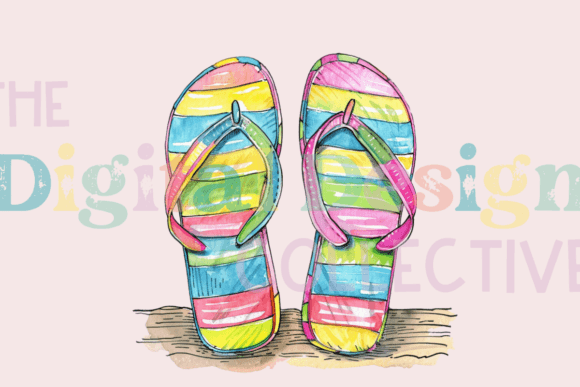
Colorful Beach Flip Flops PNG: A Practical Guide to Using High-Quality Transparent Graphics
You’ve found a set of Colorful Beach Flip Flops PNG files. Great. They promise a 300 dpi, 3000×3000 px transparent image ready for any project. But if you assume a PNG is just a PNG, you’re about to waste time, money, or both. I’ve watched designers, small business owners, and even seasoned hobbyists trip over simple details that turn a promising graphic into a frustration. Let’s walk through the mistakes that cost you results, and how to avoid them starting today.
Mistake #1: Assuming All PNGs Are Created Equal
The first misunderstanding is thinking that any transparent PNG will work in any context. That’s like assuming flip flops fit every beach. The Colorful Beach Flip Flops PNG you buy may have 300 dpi and a transparent background, but your project’s requirements can change everything.
How this hurts you: You might insert the image into a web mockup and find it looks crisp, but when you print a flyer or sticker, the edges appear fuzzy or the colors shift. Why? Because 300 dpi is fantastic for print, but some lower-quality “PNG” files are actually upscaled from smaller originals. A true 3000×3000 px file at 300 dpi yields a 10‑inch by 10‑inch print. If the source was only 72 dpi and resized, you lose clarity.
Practical advice: Before you download or purchase, confirm the file’s actual dimensions and resolution. Look for a detailed description—like the one you see here: 1 PNG file, 300 dpi, 3000×3000 px, transparent background without watermark. That’s a reliable baseline. After downloading, open the file in an image editor and check the pixel dimensions and DPI metadata. If it matches, you’re good to go for both print and high‑resolution digital use.
Mistake #2: Overlooking What “Transparent Background Without Watermark” Really Means
It sounds simple, but I’ve seen people treat a transparent PNG as a magic eraser. They assume any part of the image that looks like sky or sand will simply vanish when placed over another background. That’s not how transparency works.
How this hurts you: A well‑made Colorful Beach Flip Flops PNG has an alpha channel that makes the background invisible. But if the original asset was poorly cut—leaving fringe or halos—those edges become visible on dark or busy backgrounds. You end up with a white or jagged ghost around the flip flops, ruining the professional look you wanted.
Practical advice: Test the transparency. Place the PNG over a few different colored backgrounds—bright, dark, and a pattern. Zoom in at 200–400% to inspect edges. A clean cut has no leftover pixels. If you see artifacts, use a tool like Photoshop’s “Remove Background” or a dedicated PNG editor to clean it up. Better yet, choose a provider that guarantees a meticulously cut graphic. The description “without watermark” is nice, but “clean transparency” is the real prize.
Mistake #3: Ignoring the Color Space and File Size
You open the Colorful Beach Flip Flops PNG and the colors look vibrant on your screen. You drop it into a project and suddenly the pinks are dull, the neon greens are muddy. What happened? Color profile mismatch.
How this hurts you: Many PNG files come in sRGB (standard for web) or Adobe RGB (for print). If your editing software is set to a different profile, the colors shift. Additionally, a 3000×3000 px PNG at 300 dpi can be quite large—sometimes over 10 MB. That’s fine for print, but if you’re using it for a website or email, the bloated file size slows load times and frustrates users.
Practical advice: Check the embedded color profile. In most image editors, you can view and convert it. For web use, save a copy at 72 dpi and perhaps resize to 1500 px wide to reduce file weight while keeping quality. For print, keep the original. Also, note that a well‑optimized PNG can still be small if the image has limited colors. Test the file size before committing. A 10 MB file might be fine for a poster but overkill for a social media graphic.
Mistake #4: Using the Wrong Format for the Job
PNG is excellent for preserving transparency and sharp edges. But sometimes people use it when a vector would be smarter, or a JPEG with a solid background would do. The Colorful Beach Flip Flops PNG is a raster image—meaning it’s pixel‑based. If you need to scale it beyond 3000×3000 px, you’ll lose quality.
How this hurts you: I once saw an entrepreneur enlarge the flip flop graphic to fit a large banner. It looked blocky and cheap. They could have used a vector version or recreated the design. Similarly, if you need to edit the flip flop colors individually, a PNG makes that harder than a layered file like PSD or AI.
Practical advice: Know your output. For web banners, social media posts, or printed items smaller than 10×10 inches, the PNG is perfect. For large signage, consider whether the supplier offers a vector format or a higher resolution. If you only have the PNG, use it at 100% size or smaller to avoid interpolation artifacts. For color changes, you can use the image as a mask or recolor it in software like Photoshop with layer effects, but expect a bit of extra work.
Mistake #5: Forgetting to Check the License and Usage Terms
You buy a Colorful Beach Flip Flops PNG with a transparent background, no watermark, and high resolution. It seems ready for anything—even reselling as part of a product. But the license may say “personal use only” or “commercial use with attribution.” Ignoring that can lead to legal headaches and wasted money.
How this hurts you: Small business owners often assume a “free for commercial use” label means they can slap the image on T‑shirts and sell them. But many PNG files come from marketplaces that restrict use on merchandise, or require a separate extended license. If you’re caught using it without proper rights, you could face a takedown notice or a bill for back royalties.
Practical advice: Read the license before you download. If the seller doesn’t clearly state “commercial use allowed,” ask. For the Colorful Beach Flip Flops PNG described here, confirm whether it’s for digital projects, printed goods, or both. Keep a screenshot of the license terms with your purchase receipt. It’s also wise to check if the design includes trademarked elements (brand logos, characters) that could cause additional issues.
What to Check Before Using Your Colorful Beach Flip Flops PNG
Before you import the image into your project, do a quick checklist:
- Dimensions and DPI: 3000×3000 px at 300 dpi? Good. Verify with an image viewer.
- Transparency quality: Place over a dark background and look for jagged edges.
- Color profile: Convert to sRGB for web, keep Adobe RGB for print if needed.
- File size: Large for print, smaller for web? Consider creating resized copies.
- License: Is commercial use allowed? Can you modify it? Do you need credit?
- Background color: Even though it’s transparent, some PNGs have a subtle anti‑aliasing color on edges. Test it.
Running this check takes five minutes and saves hours of rework.
Better Workflows: Small Changes, Big Results
Instead of dropping the Colorful Beach Flip Flops PNG directly into a design, build a more reusable setup. For example:
- Save the PNG in a folder with a clear name like “flipflops_colorful_transparent_3000.png”.
- Create a master mockup file with the flip flops placed on a neutral background, complete with drop shadows or lighting adjustments. Then reuse that mockup for different products.
- If you frequently need the flip flops in various sizes, use a smart object in Photoshop so resizing is non‑destructive.
These habits turn a single PNG into a versatile asset you can deploy across social media posts, email headers, product labels, and more. The clarity you preserve by starting with a high‑quality file pays off every time you export.
Final Thoughts: Making the Most of Your Investment
A Colorful Beach Flip Flops PNG with 300 dpi, 3000×3000 px, and a transparent background is a diamond in the rough—if you handle it right. The mistakes I’ve outlined come from real experiences where something small derailed a project. By checking resolution, transparency, color profile, format suitability, and licensing, you ensure that a simple graphic works seamlessly in your workflow. Use it for summer sale banners, vacation rental marketing, scrapbooking layouts, or even custom T‑shirt designs. Just respect what the file can and cannot do, and you’ll always walk away with a finished product that looks as good as you imagined.